
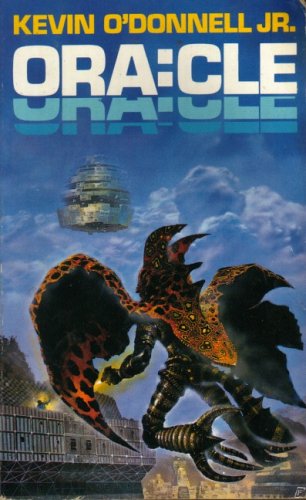
ORA:CLE is a not particularly well-known book by Kevin O’Donnell Jr, published in 1984 and which I read around 1986. This book made quite an impression on my (much!) younger self, and having unearthed it from a dusty bookshelf I gave it a fresh read.
It introduced me to concepts which now seem commonplace but were pure science fiction back then. And it turns out to have been surprisingly accurate in several of its predictions; the ubiquity of the Internet, widespread use of videocalls, remote working – including remote operation of various types of robot, climate change – including increasing frequency of extreme weather events, and integration (for some at least) of communications technology within their own bodies.
All this actually written between 1980 & 1983. Now 1983-01-01 was when TCP/IP was adopted by both the ARPANET and the Defense(sic) Data Network in the USA, and thus the birth of the modern Internet. So the time during which this was written is right around the dawn of the Internet – although only those who used it before the World Wide Web would find much recognisable.
ORA:CLE stands for “Opinions, Research, Advice: Computer Linked Experts”
The “Seeleys” (CLEs) are the Computer Linked Experts, with a brain implant enabling them to communicate directly with the ORA:CLE computer system.
Most things are internet-connected, although the term “Internet” does not appear in the book – far too early for that, and even when the terms “inter-network” & “inter-networking” were used in the early days, they tended to be hyphenated and were not proper nouns (so they got no capital letter).
Climate change is a big deal – no one is allowed outside of their residence building, no one can disturb the rich canopy of trees now flourishing on the ground; the lucky ones have a balcony.
In addition to the climate issues, there are unfriendly aliens[3], DACs, to contend with.
Shopping is done via a souped up version of Amazon (which didn’t exist back then of course), and most people work from home.
Some things are predicted but not yet fully here; remotely controlling various types of robotic equipment is still in its infancy today, with UAVs the only real extant example. In the world of ORA:CLE, paramedics, repair technicians and all sort of other specialisms are “telefactored” by their operators – who will sometimes be operating multiple semi-autonomous machines at once.
Micropayments – payments so small that our current system of charges makes the charge extremely significant. In the world of ORA:CLE, news items can be consumed for tiny payments avoiding that whole “subscription” concept.
With contactlesss payments, we seem to finally be getting close to this. Contactless payments in 2023 for mainstream cards seem to attract transaction fees of around 1% – 3%, with an “authorisation” charge between £0.01 – £0.03. I was interested to find a bridge toll recently[2] costing £0.40 which the staff preferred to take via contactless. On those figures, between £0.014 – £0.042 of each £0.40 would be taken in charges – which almost certainly makes it cheaper than cash handling.
There are also some interesting and relevant themes around anonymity and identity, and a novel but rather terrifying way of re-establishing your identity should it get “detached” from the system. Enough to put one off forgetting any passwords for a while, anyway.
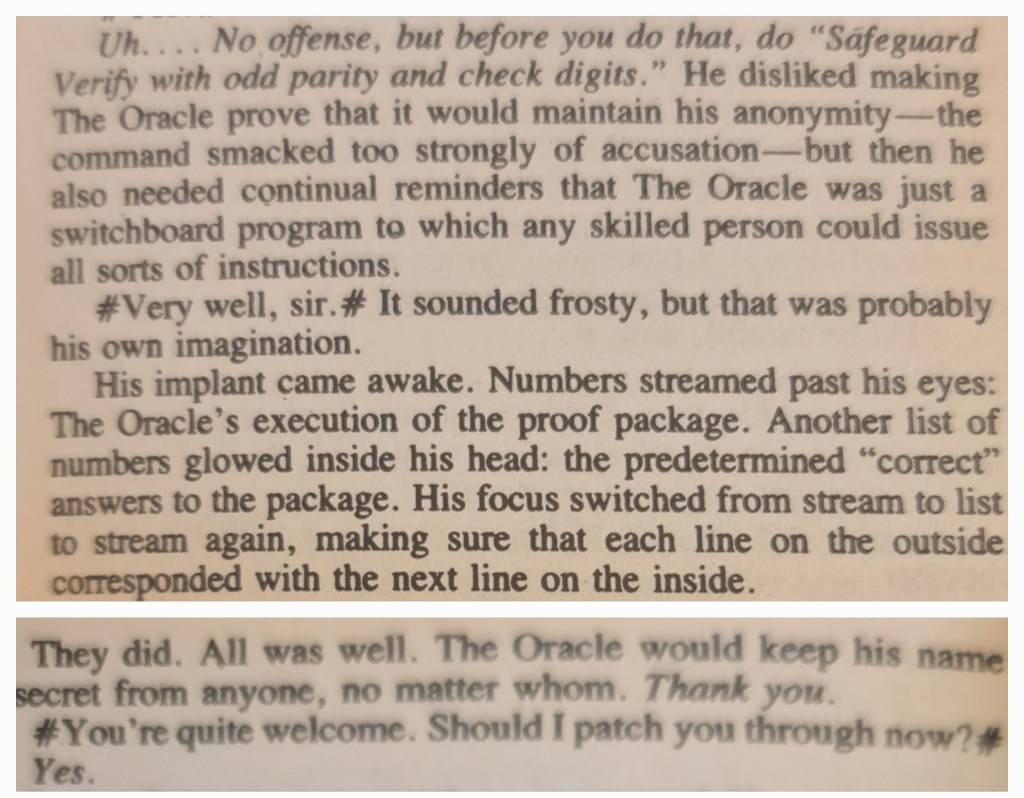
No sign of encryption in any significant fashion. But we’re only six years after the invention of RSA[4] and only nine years after the creation of DES. But the theme of trust is one running throughout the book.
So overall, an interesting book for many reasons – one which are probably more interesting than the actual plot itself, which is nothing terribly remarkable. However, it is fascinating to see so many familiar concepts being explored at a time where they were pure scifi.
Footnotes
[1] Kevin O’Donnell Jr.
Published by Berkley Pub Group, New York, 1984
ISBN 10: 0425072606 / ISBN 13: 9780425072608
Published by Grafton Books, London, 1986
ISBN 10: 0586066772
[2] Dunham Toll Bridge near Lincoln, but prices go up in July 2023!
[3] For the avoidance of doubt, xenomorphs and not foreigners!
[4] RSA invented in 1976 by by Whitfield Diffie, Martin Hellman, and Ralph Merkle. Although, unbeknownst to them (or virtually anyone) the same basic algorithm had been invented in 1973 at GCHQ in the UK – they just didn’t tell anyone much about it until 1997!
 Gânduri Eclectice - Eclectic Thoughts