
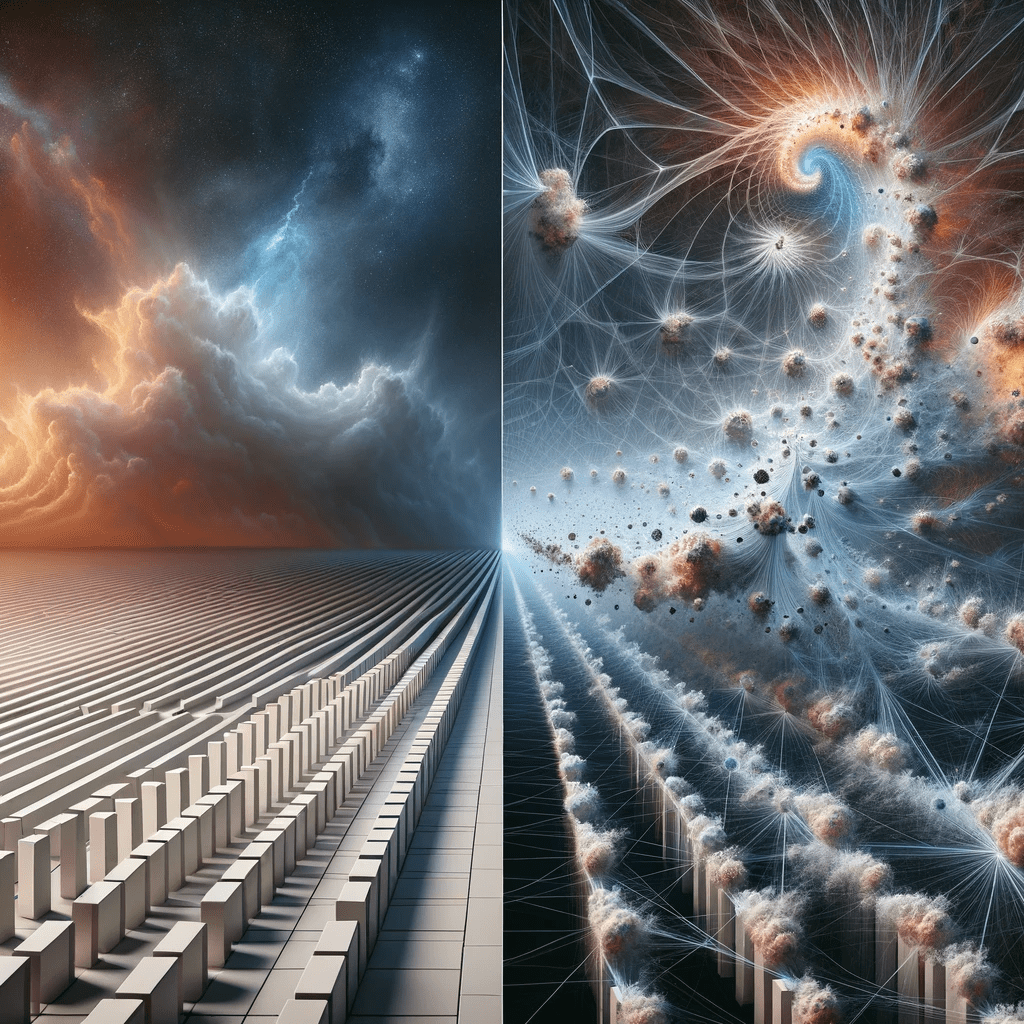
The human mind instinctively understands linear systems. These are where the output or effect is in direct proportion (or simple inverse proportion) to the input.
Put twice as much water in the kettle, it takes twice as long to boil. Run half as fast, it takes twice as long to get somewhere. Cook twice as much food, and you can feed twice the number of people.
But unfortunately, most natural systems around us tend to be non-linear. Some are linear, or close enough, but only over a specific limited range of inputs. Some are exponential. And some, unfortunately, are chaotic.
We’re not at all good, instinctively, with vehicle stopping distances; although the thinking distance is linear with the initial speed, the braking distance is related to the initial speed squared. Double the speed, and you double the thinking distance but quadruple the braking distance. We find this difficult to judge with any accuracy. And that’s just an exponential system. We tend to treat it as linear, and be surprised when we cannot stop before we hit something or someone.
When it comes to chaotic systems we frankly have no clue at all; we expect linear changes to the input to produce linear changes in the output. Like climate, for example. We treat it as linear when it quite definitely is not. We delay action on emissions reduction because surely it cannot matter that much if we delay a little? We think that, well, nothing disasterous has happened so far, so why worry – we can always do something about it later if it looks like it will REALLY be necessary. But our instincts fail to grasp the concept of tipping points; points beyond which something major changes and it’s suddenly too late to do anything about it.
[Tipping points are] critical thresholds in a system that, when exceeded, can lead to a significant change in the state of the system, often with an understanding that the change is irreversible.
The Intergovernmental Panel on Climate Change (IPCC)
Once such a point is passed, positive feedback loops force the system into a new state, and returning to the previous stable state is no longer realistically possible.
Rising global temperatures may result in rainforest becoming a dry savannah. This change is propelled by self-perpetuating feedback loops, even the driver for change in the system is removed later. The system – in this case the forest – may remain ‘tipped’ even if the temperature falls well below the threshold again.

So as our politicians put off difficult changes, crying “mañana, mañana!” as they do so for the sake of political expendiency, we plunge headlong towards irreversible changes which will render significant parts of the planet uninhabitable. Including anywhere less than a few metres above mean sea level – like most European Capital Cities.
Makes scribbled note: look at purchasing a property in Madrid, 667m, or Andorra la Vella, 1023m, forget previous favourites Barcelona, 12m(!) and the Vatican, 19m, and don’t even think about London, 11m.
If all the ice melts, the rise would be 70m wiping out even Manchester, 38m, and making the few still-visible parts of Liverpool look like Venice… but with added basement windows 😬
I wonder if it is co-incidence that Davos is the highest town in Europe, 1560m? I think we should be told.
The politicians are supposed to make difficult decisions on our behalf, not act like cowards, constantly kicking the can down the road because they don’t think they will be around when the real problems arrive. Wake up, sheeple err sheepoliticians! Have you seen what climate change is already doing to the world’s weather? Greenland is going green as foliage replaces the ice (incidentally increasing emissions from ancient stores in the process), Iceland is becoming Rockland, and the weather all around the globe is more extreme.
Maybe they don’t teach non-leanear dynamics at Eaton & Harrow? Mind you, I wasn’t taught it, it’s just self-apparent if you have any sort of basic scientific background. Unlike, it would appear, all of our Politicians. Be afraid, very afraid.
Until either our politicians find some principles and courage (don’t hold your breath) or we elect new ones who already have these attributes, I fear for the future and for the future of my children and, in turn, their children.
There’s a cheerful thought to end the week upon.
 Gânduri Eclectice - Eclectic Thoughts